


Market-Moving News[i]
Election!
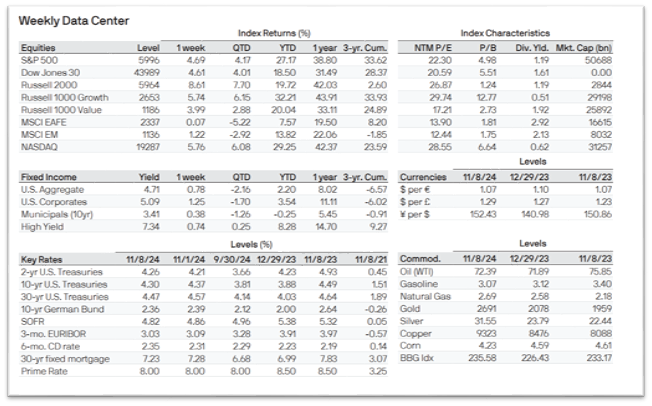
As the dust settles post-election, investors are keenly assessing what the next four years might bring. Despite the policy uncertainties that accompany a unified Republican government, the economic outlook remains largely stable. Additionally, market fundamentals look strong and matter more for returns, especially over the long term.
Economic Growth
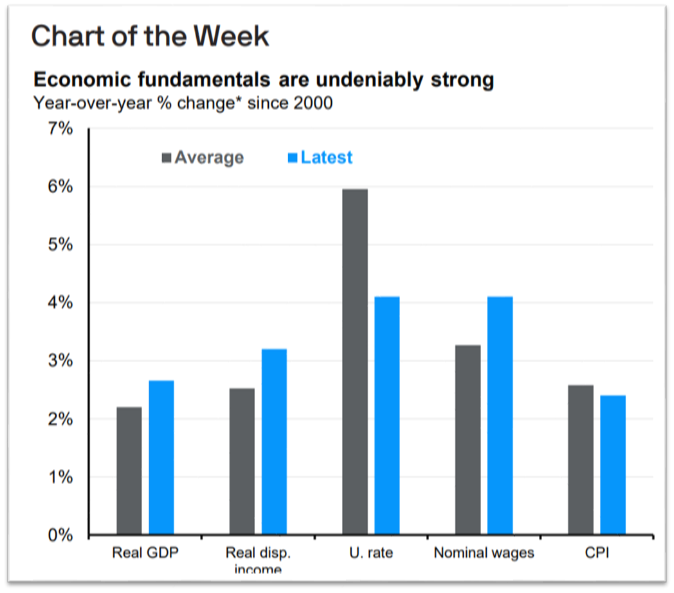
The U.S. economy continues to be a straight A student, with GDP growth above trend (3Q24: 2.8% q/q saar), full employment (October unemployment rate: 4.1%), and low inflation (September CPI: 2.4% y/y), as shown in this week’s chart. Consumers are maintaining their spending habits despite dissatisfaction with mortgage rates, which are higher than before the pandemic, and the price increases of the past few years. However, this confidence may be shifting, as evidenced by the Consumer Confidence Index's significant monthly increase—the largest since March 2021—rising to 108.7 in October from 99.2 in September. Notably, all five components of the index improved, indicating growing confidence in future job availability and stock market gains.
Equity markets
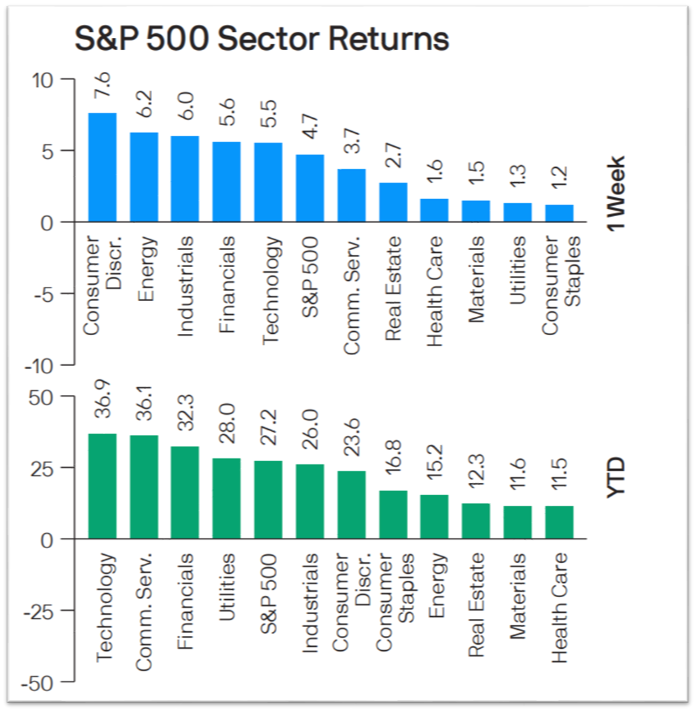
This economic environment is favorable for equity markets. Declining interest rates and real wage gains are positive for consumer spending, and S&P 500 operating margins are 8% above long-term averages, showcasing the dynamism of U.S. companies. Additionally, secular trends continue to encourage corporate investment. Besides high valuations, there are few reasons to anticipate a disruption in the upward trajectory of equities.
New administration
The effects of the new administration's policies won’t be apparent for a while, so investors should refocus on the fundamentals, which are undeniably strong.
The Week Ahead: Nov 11-15
- Consumer price index
- CPI year-over-year
- Jobless claims
- Producer price index
- Powell speaks
- US retail sales
- Business inventories
Philosophy Quote of the Week[ii]
Never complain, never explain
“Don’t allow yourself to be heard any longer griping about public life, not even with your own years.”
Marcus Aurelius, Meditations, 8.9
Not only do even the most fortunate of us complain, it often seems like the more fortunate we are, the more time we have to do so. Marcus Aurelius was a reluctant chief executive – just as you might be a reluctant accountant, kid’s soccer coach or lawyer. Or perhaps you generally like your job, but you could do without a few of its attendant responsibilities. Where does that thinking get you? Nowhere, other than in a negative state of mind.
It calls to mind a motto of British prime minister Benjamin Disraeli: “Never complain, never explain.” He said this because, like Marcus, he knew that the burdens of responsibility were immense. It’s so easy to complain about this or that, or to try to make excuses and justifications for the things you’ve done. But that doesn’t accomplish anything – and it never lightens the load.
Tax Tips[iii]
Money Saving and Tax Tips for the Holidays
The Holiday Season is here! The bright red ornaments, Santa and the dazzling gift-wrapped parcels sitting almost everywhere in town surely entices you to indulge in the holiday spirit. The holidays are upon us. It should be a pleasant time, but too often the enjoyment we experience is followed by financial stress, worries and/or headache.
Money Savings Tips
January’s bank and credit card statements bring the realization that once again we lost our minds and busted our budget. Who says we can’t enjoy the holidays and indulge in the holiday spirit?! However, enjoying that spirit does not necessary translate into overspending.
Before the holidays begin, consider making a budget. Estimate the cost of what you plan to buy, and if the total cost is manageable, then stick to it as you shop. If it’s not, then look for ways to cut back.
Here is a rule of thumb: your credit card bill for the holidays should be paid off in 90 days. If it takes more than 90 days to pay your holiday debt off, you spent too much!
Consider ways to save on holiday gifts:
- Many families can draw names and give one nice gift to a person rather than multiple small ones
- Make or bake gifts instead of buying them
- Give combined gifts from parents or children instead of individuals
- Agree with your close friends on a spending limit
The holidays are a special time for children! Don’t give in – curb your excesses so you can be a good example for them! You don’t have to give kids everything they want!
- When they make a holiday list, have them prioritize what they want
- Don’t forget, favored toys are often simple toys that allow them to use their imagination
- Show your children there is more to the holidays than simply receiving presents
- Have them participate in choosing and wrapping presents for a less fortunate child
- Encourage them to make their own gifts for family and friends
- Arrange family outings and fun activities, so the holidays become a series of joyful events
Spending Tips to Remember
- Set a budget
- Pay off credit cards in 90 days
- Save on gifts – make or bake!
- Buy one nice gift instead of many small gifts
- Give combined gifts from parents or children
- Teach your children how to participate in the holidays (have them choose or wrap gifts for a less fortunate child)
- Have children make their own gifts for family or friends
Tax Tips for the Holidays
Holiday meal deductions are worth 100% deductions
If an employer or owner of a small business takes employees out to lunch or pays for a gift like a birthday, graduation, wedding, anniversary, baptism, or bar (bat) mitzvah, then there is only a 50% tax deduction for the cost of the meal, entertainment and/or gift.
If an employer/owner purchases a small holiday gift such as a turkey, ham, or bottle of wine, half of the cost of the purchase is allowed. The only things that need to be proven to receive this 100% tax deduction are the date, place purpose and dollar amount spent. This will allow the company or business owner the opportunity to write off the deduction at 100%.
The IRS does not define what holidays are allowed for this deduction. So, whether you are Christian, Muslim, Jewish, Hindu or a member of any other faith, you should be able to justify a holiday meal at 100% deduction or a business that is paying for it. You are eligible to benefit form it if you are self-employed, with employees, or own a corporation and you are an employee as well.
Key Tips to Remember
- Holiday meals are fully deductible (100% write off)
- Small holiday gifts that are given are deductible to the employer or business owner (ham, turkey, wine)
- The documentation that is required to claim the total deduction is the date, purpose of meal or gift, place of meal or gift and dollar amount.
Remember – always contact your tax professional for help! That’s what you pay them for!
Long-Term Care Planning Month[iv]
Does an Older Adult in Your Life Need Help?
It is not always clear whether an aging parent or relative needs help. Sometimes a person will recognize that they need help and request it, or an emergency or sudden illness will make it clear. Others may not want to cause worry or admit they’re struggling. If you become aware of the signs that a loved one needs help, you will be better prepared to provide support for their safety and well-being.
How to tell if someone needs extra support
The best way to know what someone needs is to ask them directly. But a phone call, email, or text message is not always the best way to tell whether an older person needs help. These signs may indicate that someone needs extra support:
- Changes at home. When you spend time at the person’s home, you might notice possible trouble spots. Some examples include:
- Can the person prepare meals on a stove safely?
- Are they bathing regularly and wearing appropriate clothing for the weather?
- Is the home relatively clean and free of clutter?
- Do they have the medications they need, and are they taking them regularly?
Mental health concerns
Changes in a person’s mood could indicate a need for help. Sometimes depression in older people is confused with normal aging. An older person with depression might brighten up for a phone call or short visit, but it’s harder to hide serious mood problems during an extended visit. Seek immediate help if the person says they feel hopeless or have no reason to live, or if you’re worried they may harm themselves. Call or text the 24-hour 988 Suicide & Crisis Lifeline at 988 or call 800-273-TALK (800-273-8255). For TTY, use your preferred relay service or dial 711 then 988.
Signs related to the person’s general health that can raise concerns include:
- Significant weight gain or weight loss
- Poor hygiene
- Confusion
- Falls
- Loneliness or social isolation
- Trouble walking or getting around
Memory issues
Occasional forgetfulness is a normal part of aging. But more significant memory problems, changes in thinking ability or personality, or poor decision-making could indicate a serious condition that requires medical attention.
Recognizing changes if you live far away
- If you don’t live close to an older family member or see them often, it may be difficult to notice if the person needs help.
- With the person’s permission, you could contact people who see them regularly — neighbors, friends, doctors, or local relatives, for example — and ask them to call you with any concerns. You might also ask if you can check in periodically.
- Read more about long-distance caregiving.
What to do when a loved one needs help
- When you notice signs that your aging parent or relative needs help, it is important to know what steps to take next. Some issues have a simple fix, like needing a new glasses prescription. But other times, you may need to provide more support.
- Your first step may be to talk to the older person about your concerns. Mention your worry without sounding critical, such as, “Mom, it looks like you don’t have much food in the house. Are you having trouble getting to the store?”
- Then try to fulfill the person’s wishes to the extent possible. For example, if they want to keep cooking at home, you could ask, “Would you like me to arrange to have groceries delivered on a regular basis?” Try to include practical help with your suggestions and give specific examples of what can be done.
- If you’re concerned about the person’s physical or mental health, suggest a visit to a health care provider. You might offer to make the appointment, give them a ride, or go with them to see the doctor.
You don’t have to do everything yourself
In many communities, a variety of services are available to help older people. Depending on the person’s needs, you might hire a home health aide to visit on a regular basis, arrange transportation so the person can run errands, or speak with a geriatric care manager to help coordinate care.
You can also find ways to share caregiving responsibilities with other family members, neighbors, or friends
- Helping an aging parent or other relative plan for the future
- The best time to plan is before the older person needs extensive help. Planning for the possibility of long-term caregives you and your family time to learn about services available in your community and what they cost. It also allows the older person to make important decisions while they are still able.
- There may be a time when your older relative can no longer live independently at home. Learn as much as you can about housing options, which may include moving to a residential facility(such as a nursing home or assisted living) or living with a family member. These choices may depend on the person’s health, ability to perform activities of daily living, financial resources, and personal preferences. Talk about the pros and cons of each option before making a decision.
- You may also need to help the older person prepare for decisions about their future medical care — a process called advance care planning. It’s important to know what they would want if they became seriously ill or unable to communicate their wishes. Having conversations about the person’s preferences and making a plan makes it more likely that they will get the care they want.
[i]https://am.jpmorgan.com/content/dam/jpm-am-aem/americas/us/en/insights/market-insights/wmr/weekly_market_recap.pdf. Accessed 11.13.2024. Chart of the Week: Source: Bloomberg, ICE BofA, Standard & Poor's, J.P. Morgan Asset Management. The 60/40 portfolio is rebalanced on a monthly basis, and is 60% invested in the S&P 500 Total Return Index and 40% invested in the Bloomberg U.S. Aggregate Total Return Index. Thought of the week: Source: Bloomberg, World Gold Council, J.P. Morgan Asset Management. Abbreviations: Cons. Sent.: University of Michigan Consumer Sentiment Index; CPI: Consumer Price Index; EIA: Energy Information Agency; FHFA HPI: - Federal Housing Finance Authority House Price Index; FOMC: Federal Open Market Committee; GDP: gross domestic product; HPI: Home Price Index; HMI: Housing Market Index; ISM Mfg. Index: Institute for Supply Management Manufacturing Index; PCE: Personal consumption expenditures; Philly Fed Survey: Philadelphia Fed Business Outlook Survey; PMI: Purchasing Managers' Manufacturing Index; PPI: Producer Price Index; SAAR: Seasonally Adjusted Annual Rate Equity Price Levels and Returns: All returns represent total return for stated period. Index: S&P 500; provided by: Standard & Poor’s. Index: Dow Jones Industrial 30 (The Dow Jones is a price-weighted index composing of 30 widely-traded blue chip stocks.) ; provided by: S&P Dow Jones Indices LLC. Index: Russell 2000; provided by: Russell Investments. Index: Russell 1000 Growth; provided by: Russell Investments. Index: Russell 1000 Value; provided by: Russell Investments. Index: MSCI – EAFE; provided by: MSCI – gross official pricing. Index: MSCI – EM; provided by: MSCI – gross official pricing. Index: Nasdaq Composite; provided by: NASDAQ OMX Group. MSCI EAFE is a Morgan Stanley Capital International Index that is designed to measure the performance of the developed stock markets of Europe, Australasia, and the Far East. Bond Returns: All returns represent total return. Index: Bloomberg US Aggregate; provided by: Bloomberg Capital. Index: Bloomberg Investment Grade Credit; provided by: Bloomberg Capital. Index: Bloomberg Municipal Bond 10 Yr; provided by: Blomberg Capital. Index: Bloomberg Capital High Yield Index; provided by: Bloomberg Capital. Key Interest Rates: 2 Year Treasury, FactSet; 10 Year Treasury, FactSet; 30 Year Treasury, FactSet; 10 Year German Bund, FactSet. 3 Month LIBOR, British Bankers’ Association; 3 Month EURIBOR, European Banking Federation; 6 Month CD, Federal Reserve; 30 Year Mortgage, Mortgage Bankers Association (MBA); Prime Rate: Federal Reserve. Commodities: Gold, FactSet; Crude Oil (WTI), FactSet; Gasoline, FactSet; Natural Gas, FactSet; Silver, FactSet; Copper, FactSet; Corn, FactSet. Bloomberg Commodity Index (BBG Idx), Bloomberg Finance L.P. Currency: Dollar per Pound, FactSet; Dollar per Euro, FactSet; Yen per Dollar, FactSet. S&P Index Characteristics: Dividend yield provided by FactSet Pricing database. Fwd. P/E is a bottom-up weighted harmonic average using First Call Mean estimates for the "Next 12 Months" (NTM) period. Market cap is a bottom-up weighted average based on share information from Compustat and price information from FactSet's Pricing database as provided by Standard & Poor's. MSCI Index Characteristics: Dividend yield provided by FactSet Pricing database. Fwd. P/E is a bottom-up weighted harmonic average for the "Next 12 Months" (NTM) period. Market cap is a bottom-up weighted average based on share information from MSCI and Price information from FactSet's Pricing database as provided by MSCI. Russell 1000 Value Index, Russell 1000 Growth Index, and Russell 2000 Index Characteristics: Trailing P/E is provided directly by Russell. Fwd. P/E is a bottom-up weighted harmonic average using First Call Mean estimates for the "Next 12 Months" (NTM) period. Market cap is a bottom-up weighted average based on share information from Compustat and price information from FactSet's Pricing database as provided by Russell. Sector Returns: Sectors are based on the GICS methodology. Return data are calculated by FactSet using constituents and weights as provided by Standard & Poor’s. Returns are cumulative total return for stated period, including reinvestment of dividends. Style Returns: Style box returns based on Russell Indexes with the exception of the Large-Cap Blend box, which reflects the S&P 500 Index. All values are cumulative total return for stated period including the reinvestment of dividends. The Index used from L to R, top to bottom are: Russell 1000 Value Index (Measures the performance of those Russell 1000 companies with lower price-to-book ratios and lower forecasted growth values), S&P 500 Index (Index represents the 500 Large Cap portion of the stock market, and is comprised of 500 stocks as selected by the S&P Index Committee), Russell 1000 Growth Index (Measures the performance of those Russell 1000 companies with higher price-to-book ratios and higher forecasted growth values), Russell Mid Cap Value Index (Measures the performance of those Russell Mid Cap companies with lower price-to-book ratios and lower forecasted growth values), Russell Mid Cap Index (The Russell Midcap Index includes the smallest 800 securities in the Russell 1000), Russell Mid Cap Growth Index (Measures the performance of those Russell Mid Cap companies with higher price-to-book ratios and higher forecasted growth values), Russell 2000 Value Index (Measures the performance of those Russell 2000 companies with lower price-to-book ratios and lower forecasted growth values), Russell 2000 Index (The Russell 2000 includes the smallest 2000 securities in the Russell 3000), Russell 2000 Growth Index (Measures the performance of those Russell 2000 companies with higher price-to-book ratios and higher forecasted growth values). Past performance does not guarantee future results. Diversification does not guarantee investment returns and does not eliminate the risk of loss. Opinions and estimates offered constitute our judgment and are subject to change without notice, as are statements of financial market trends, which are based on current market conditions. We believe the information provided here is reliable, but do not warrant its accuracy or completeness. This material is not intended as an offer or solicitation for the purchase or sale of any financial instrument. The views and strategies described may not be appropriate for all investors. This material has been prepared for informational purposes only, and is not intended to provide, and should not be relied on for, accounting, legal or tax advice. References to future returns are not promises or even estimates of actual returns a client portfolio may achieve. Any forecasts contained herein are for illustrative purposes only and are not to be relied upon as advice or interpreted as a recommendation. The Market Insights program provides comprehensive data and commentary on global markets without reference to products. Designed as a tool to help clients understand the markets and support investment decision-making, the program explores the implications of current economic data and changing market conditions. The J.P. Morgan Asset Management Market Insights and Portfolio Insights programs, as non-independent research, have not been prepared in accordance with legal requirements designed to promote the independence of investment research, nor are they subject to any prohibition on dealing ahead of the dissemination of investment research. This document is a general communication being provided for informational purposes only. It is educational in nature and not designed to be taken as advice or a recommendation for any specific investment product, strategy, plan feature or other purpose in any jurisdiction, nor is it a commitment from J.P. Morgan Asset Management or any of its subsidiaries to participate in any of the transactions mentioned herein. Any examples used are generic, hypothetical and for illustration purposes only. This material does not contain sufficient information to support an investment decision and it should not be relied upon by you in evaluating the merits of investing in any securities or products. In addition, users should make an independent assessment of the legal, regulatory, tax, credit, and accounting implications and determine, together with their own financial professional, if any investment mentioned herein is believed to be appropriate to their personal goals. Investors should ensure that they obtain all available relevant information before making any investment. Any forecasts, figures, opinions or investment techniques and strategies set out are for information purposes only, based on certain assumptions and current market conditions and are subject to change without prior notice. All information presented herein is considered to be accurate at the time of production, but no warranty of accuracy is given and no liability in respect of any error or omission is accepted. It should be noted that investment involves risks, the value of investments and the income from them may fluctuate in accordance with market conditions and taxation agreements and investors may not get back the full amount invested. Both past performance and yields are not reliable indicators of current and future results. J.P. Morgan Asset Management is the brand for the asset management business of JPMorgan Chase & Co. and its affiliates worldwide. Telephone calls and electronic communications may be monitored and/or recorded. Personal data will be collected, stored and processed by J.P. Morgan Asset Management in accordance with our privacy policies at https://www.jpmorgan.com/privacy. This communication is issued by the following entities: In the United States, by J.P. Morgan Investment Management Inc. or J.P. Morgan Alternative Asset Management, Inc., both regulated by the Securities and Exchange Commission; in Latin America, for intended recipients’ use only, by local J.P. Morgan entities, as the case may be.; in Canada, for institutional clients’ use only, by JPMorgan Asset Management (Canada) Inc., which is a registered Portfolio Manager and Exempt Market Dealer in all Canadian provinces and territories except the Yukon and is also registered as an Investment Fund Manager in British Columbia, Ontario, Quebec and Newfoundland and Labrador. If you are a person with a disability and need additional support in viewing the material, please call us at 1-800-343-1113 for assistance. Copyright 2024 JPMorgan Chase & Co. All rights reserved. ©JPMorgan Chase & Co., November 2024. Unless otherwise stated, all data is as of November 4, 2024 or as of most recently available.
[ii] Holiday, Ryan. The Daily Stoic: 366 Meditations on Wisdom, Perseverance, and the Art of Living. Kindle edition, pages 337-338. Accessed 11.13.2024.
[iii] Hockensmith, Robert F. 52 Ways to Outsmart the IRS, Weekly Tax Tips to Save You Money. Kindle edition, page 198-200, accessed 11.13.2024.
[iv]https://www.nia.nih.gov/health/caregiving/does-older-adult-your-life-need-help, accessed 11.13.2024.